Organizational Readiness in Industry 4.0: Mapping the Missing Link between Technology, Human Factors, and Digital Transformation
Keywords:
Digital twins, human factors, manufacturing, readinessAbstract
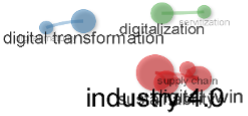
This study aims to map the research landscape of digital transformation and Industry 4.0 through a multidisciplinary approach. A Systematic Literature Review (SLR) was conducted on 21 articles published between 2022 and 2023, obtained through a filtered search on ScienceDirect. The bibliometric analysis indicates that Industry 4.0 represents the dominant cluster with the highest frequency (20 occurrences), followed by digital transformation (6 occurrences) and digitalization (5 occurrences). Central concepts such as digital twin, sustainability, manufacturing, and supply chain also show significant PageRank values, including manufacturing (1,193,667), digitalization (1,017,000), and Industry 4.0 (889,500). However, the correspondence analysis highlights a thematic distance from human factors and organizational readiness, with keywords such as digital readiness (-4.24, -0.36) and employee’s perspective being less integrated into the mainstream discourse. These findings suggest that research on digital transformation in manufacturing remains polarized between the digitalization of core processes (e.g., manufacturing, supply chain, automation) and the development of new conceptual frameworks (e.g., organizational readiness, digital maturity, and the biologization of manufacturing). The main contribution of this study lies in identifying the integration gap between technology, human factors, and organizational readiness in the context of Industry 4.0, thereby offering directions for future research to expand the focus toward strategic dimensions, sustainability, and digital business model innovation.
References
Abouzid, I., & Saidi, R. (2023). Digital twin implementation approach in supply chain processes. Scientific African, 21(March), e01821. https://doi.org/10.1016/j.sciaf.2023.e01821
Chari, A., Stahre, J., Bärring, M., Despeisse, M., Li, D., Friis, M., Mörstam, M., & Johansson, B. (2023). Analyzing the antecedents to digital platform implementation for resilient and sustainable manufacturing supply chains - An IDEF0 modeling approach. Journal of Cleaner Production, 429(August). https://doi.org/10.1016/j.jclepro.2023.139598
Chari, A., Stahre, J., Maja, B., Li, D., & Friis, M. (2023). Analyzing the antecedents to digital platform implementation for resilient and sustainable manufacturing supply chains - An IDEF0 modeling approach Arpita. 429(November). https://doi.org/10.1016/j.jclepro.2023.139598
Clausen, P. (2023). Towards the Industry 4.0 agenda: Practitioners' reasons why a digital transition of shop floor management visualization boards is warranted. Digital Business, 3(2), 100063. https://doi.org/10.1016/j.digbus.2023.100063
Davila, M. F. R., Schwark, F., Dawel, L., & Pehlken, A. (2023). Sustainability Digital Twin: a tool for the manufacturing industry. Procedia CIRP, 116, 143–148. https://doi.org/10.1016/j.procir.2023.02.025
Gaglio, C., Kraemer-Mbula, E., & Lorenz, E. (2022). The effects of digital transformation on innovation and productivity: Firm-level evidence from South African manufacturing micro and small enterprises. Technological Forecasting and Social Change, 182(March), 121785. https://doi.org/10.1016/j.techfore.2022.121785
González Chávez, C.A., Unamuno, G., Despeisse, M., Johansson, B., Romero, D., & Stahre, J. (2023). Analyzing the risks of digital servitization in the machine tool industry. Robotics and Computer-Integrated Manufacturing, 82(August 2022). https://doi.org/10.1016/j.rcim.2022.102520
Hajoary, P. K. (2022). Industry 4.0 Maturity and Readiness- A case of a Steel Manufacturing Organization. Procedia Computer Science, 217(2022), 614–619. https://doi.org/10.1016/j.procs.2022.12.257
Holmström, J. (2022). From AI to digital transformation: The AI readiness framework. Business Horizons, 65(3), 329–339. https://doi.org/10.1016/j.bushor.2021.03.006
Holopainen, M., Ukko, J., & Saunila, M. (2022). Managing the strategic readiness of industrial companies for digital operations. Digital Business, 2(2), 100039. https://doi.org/10.1016/j.digbus.2022.100039
Kryukov, V., Shakhgeldyan, K., Kiykova, E., Kiykova, D., & Saychuk, D. (2022). Assessment of transport enterprise readiness for digital transformation. Transportation Research Procedia, 63, 2710–2718. https://doi.org/10.1016/j.trpro.2022.06.313
Musyarofah, SA, Tontowi, AE, Masruroh, NA, & Wibowo, BS (2023). Developing supply chain readiness measurement tool for the manufacturing industrial estates. Journal of Open Innovation: Technology, Markets, and Complexity, 9(1), 100019. https://doi.org/10.1016/j.joitmc.2023.100019
P. Senna, P., Barros, A.C., Bonnin Roca, J., & Azevedo, A. (2023). Development of a digital maturity model for Industry 4.0 based on the technology-organization-environment framework. Computers and Industrial Engineering, 185(September). https://doi.org/10.1016/j.cie.2023.109645
Panagiotopoulou, V. C., & Stavropoulos, P. (2023). Developing a methodology for integrating Digital Tools in Biological Manufacturing. Procedia CIRP, 118, 993–997. https://doi.org/10.1016/j.procir.2023.06.194
Piccialli, F., Chiaro, D., Sarwar, S., Cerciello, D., Qi, P., & Mele, V. (2025). AgentAI: A comprehensive survey on autonomous agents in distributed AI for industry 4.0. Expert Systems with Applications, 291(May), 128404. https://doi.org/10.1016/j.eswa.2025.128404
Rais, M.H., Ahsan, M., & Ahmed, I. (2023). FRoMEPP: Digital forensic readiness framework for material extrusion based 3D printing process. Forensic Science International: Digital Investigation, 44, 301510. https://doi.org/10.1016/j.fsidi.2023.301510
Riquelme-Medina, M., Stevenson, M., Barrales-Molina, V., & Llorens-Montes, F.J. (2022). Coopetition in business Ecosystems: The key role of absorptive capacity and supply chain agility. Journal of Business Research, 146(November 2021), 464–476. https://doi.org/10.1016/j.jbusres.2022.03.071
Rodríguez-Espíndola, O., Chowdhury, S., Dey, P.K., Albores, P., & Emrouznejad, A. (2022). Analysis of the adoption of emergent technologies for risk management in the era of digital manufacturing. Technological Forecasting and Social Change, 178(February 2021), 121562. https://doi.org/10.1016/j.techfore.2022.121562
Seegrün, A., Kruschke, T., Mügge, J., Hardinghaus, L., Knauf, T., Riedelsheimer, T., & Lindow, K. (2023). Sustainable product lifecycle management with Digital Twins: A systematic literature review. Procedia CIRP, 119, 776–781. https://doi.org/10.1016/j.procir.2023.03.124
Silva, R.P., Saraiva, C., & Mamede, H.S. (2022). Assessment of organizational readiness for digital transformation in SMEs. Procedia Computer Science, 204(2021), 362–369. https://doi.org/10.1016/j.procs.2022.08.044
Soleymanizadeh, H., Qu, Q., Bamakan, S.M.H., & Zanjirchi, S.M. (2023). Digital Twin Empowering Manufacturing Paradigms: Lean, Agile, Just-in-Time (Jit), Flexible, Resilience, Sustainable. Procedia Computer Science, 221, 1258–1267. https://doi.org/10.1016/j.procs.2023.08.114
Tabares, S., Parida, V., & Visnjic, I. (2023). Revenue models for digital services in the railway industry: A framework for choosing the right revenue model. Journal of Business Research, 165(May), 114041. https://doi.org/10.1016/j.jbusres.2023.114041
Tanveer, U., Kremantzis, M.D., Roussinos, N., Ishaq, S., Kyrgiakos, L.S., & Vlontzos, G. (2023). A fuzzy TOPSIS model for selecting digital technologies in circular supply chains. Supply Chain Analytics, 4(September), 100038. https://doi.org/10.1016/j.sca.2023.100038
Tomelleri, F., Sbaragli, A., Picariello, F., & Pilati, F. (2024). Digital ergonomic assessment to enhance the physical resilience of human-centric manufacturing systems in Industry 5.0. Journal of Manufacturing Systems, 77, 246–265. https://doi.org/10.1016/j.jmsy.2024.09.003
Trabert, T., Beiner, S., Lehmann, C., & Kinkel, S. (2022). Digital Value Creation in Sociotechnical Systems. Procedia Computer Science, 200(2019), 471–481. https://doi.org/10.1016/j.procs.2022.01.245
Downloads
Published
How to Cite
Issue
Section
License
Copyright (c) 2025 Rizal Ardianto, Danny Dwi Rachmanto, Feni Ira Puspita, Adinda Sukma Novelia, Siti Fatimah, Bamban Handriyanto

This work is licensed under a Creative Commons Attribution-NonCommercial-ShareAlike 4.0 International License.
This material is licensed under the Creative Commons Attribution-NonCommercial-ShareAlike 4.0 International (CC BY-NC-SA 4.0). This license permits users to copy, distribute, and adapt the material, provided that appropriate credit is given, a link to the license is provided, and any modifications are clearly indicated. The material may only be utilized for non-commercial purposes and must not be exploited for commercial gain. Any derivative works, adaptations, or modifications must be distributed under the same license as the original. For further details, please refer to the Creative Commons BY-NC-SA 4.0.
 Chers Publishers