From Product Attributes to Market Advantage: Game Theory Applications in Bicycle Industry Competition
Keywords:
Game Theory, MTB, Positioning, Simplex, SeatpostAbstract
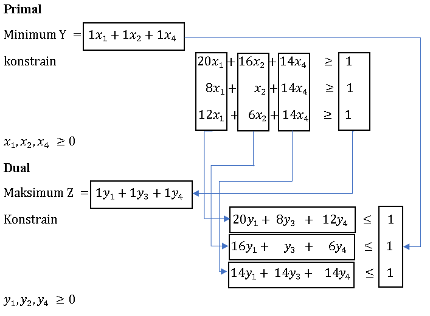
This study addresses the competitive challenge between two mountain bike brands, Senator MTB and Aviator MTB, in capturing consumer preference within the East Java market. The research object focuses on product attribute comparison between the two brands, aiming to identify the optimal strategic positioning for each. The objective is to determine competitive strategies that minimize losses and maximize gains using a quantitative approach. Data were collected through a closed-ended Google Form survey distributed to 31 respondents, consisting of MTB users in East Java. The analysis employed paired comparison, Game Theory, and the primal–dual Simplex method, supported by validity, reliability, and data sufficiency tests. Results showed that Aviator, as the column player, minimized its loss to -7,714 units with a mixed strategy equally focusing (50.7% each) on a lightweight and rigid frame and a strong derailleur, while Senator, as the row player, maximized its gain to -7,715 units through a pure strategy fully (100%) leveraging the durability of the seatpost–stem–handlebar combination. The study concludes that Game Theory can effectively identify and quantify optimal strategies in product competition. The contribution of this research lies in providing empirical evidence of applying Game Theory in the bicycle industry to guide strategic product development and market positioning.
References
Antonius, F. (2024). Efficient resource allocation through CNN-game theory based network slicing recognition for next-generation networks. Journal of Engineering Research (Kuwait), 12(4), 793–805. https://doi.org/10.1016/j.jer.2024.01.018
Ibrahim Fahad Sulaiman, Ahmed Abdul Malik, & Zainab Masud Abdul Raheem. (2024). The Role of Transformational Leadership Style on Islamic Management. Journal of Scientific Research, Education, and Technology (JSRET), 3(1), 340–348. https://doi.org/10.58526/jsret.v3i1.326
Kurniawan, I., Muslihah, E., & Syarifudin, E. (2022). KYAI'S LEADERSHIP MODEL IN ISLAMIC EDUCATIONAL INSTITUTIONS, ISLAMIC BOARDING SCHOOL: A LITERATURE STUDY. International Journal of Graduate Islamic Education, 3, 302.
Ma, Y., Lu, Y., Yin, Y., & Lei, Y. (2024). Pricing strategy of V2G demand response for industrial and commercial enterprises based on cooperative game. International Journal of Electrical Power and Energy Systems, 160(March), 110051. https://doi.org/10.1016/j.ijepes.2024.110051
Maldonado-Carrascosa, F.J., García-Galán, S., Valverde-Ibáñez, M., Marciniak, T., Szczerska, M., & Ruiz-Reyes, N. (2024). Game theory-based virtual machine migration for energy sustainability in cloud data centers. Applied Energy, 372(January), 123798. https://doi.org/10.1016/j.apenergy.2024.123798
Maleki Vishkaei, B., & De Giovanni, P. (2025). A smart mobility game with blockchain and hardware oracles. International Journal of Production Economics, 282(December 2024), 109533. https://doi.org/10.1016/j.ijpe.2025.109533
Marousi, A., Thyagarajan, K., Pinto, J.M., Papageorgiou, L.G., & Charitopoulos, V.M. (2024). Game-theoretic optimization of supply chain design with customer contracts: The case of industrial gases market. Computers and Chemical Engineering, 184(October 2023), 108625. https://doi.org/10.1016/j.compchemeng.2024.108625
Noorhayati, SM, & Fahyuni, EF (2024). The Role of Leadership in Improving Managerial Accountability at Islamic Higher Education. Nidhomul Haq: Journal of Islamic Education Management, 9(2), 239–253. https://doi.org/10.31538/ndh.v9i2.4584
Perumalsamy, D., Johnson, S., & Thinakaran, R. (2025). Unraveling health impacts of individuals in industrial zones: Leveraging game theory-based LSTM approach for predictive analysis of public health dynamics. Ain Shams Engineering Journal, 16(10), 103579. https://doi.org/10.1016/j.asej.2025.103579
Sulthon Sulaiman, Achmad Patoni, Ngainun Naim, & Ahmad Supriyadi. (2024). Kiai Charismatic Leadership in Developing the Mamba'ul Ma'arif Denanyar Islamic Boarding School. International Journal of Science, Technology & Management, 5(1), 50–59. https://doi.org/10.46729/ijstm.v5i1.1056
Ubaidillah, M., Mustofa, A., Gultom, RZ, Fadlur, A., Bayuny, R., Aliyul, M., & Al Mustofa, H. (2022). Transactional And Transformational Leaderships In Islamic Perspectives. Indonesian Journal of Development Studies (IJDS), 2022(1), 13–19.
Yin, S., Sun, W., & Wang, H. (2025). Virtual power plant capacity tariff pricing method based on master–slave game. International Journal of Electrical Power and Energy Systems, 169(May), 110774. https://doi.org/10.1016/j.ijepes.2025.110774
Yuwono, S., Hussain, AK, Schwung, D., & Schwung, A. (2025). Self-optimization in distributed manufacturing systems using Modular State-based Stackelberg games. Journal of Manufacturing Systems, 80(March), 578–594. https://doi.org/10.1016/j.jmsy.2025.03.025
Downloads
Published
How to Cite
Issue
Section
License
Copyright (c) 2025 Anang Siswanto

This work is licensed under a Creative Commons Attribution-NonCommercial-ShareAlike 4.0 International License.
This material is licensed under the Creative Commons Attribution-NonCommercial-ShareAlike 4.0 International (CC BY-NC-SA 4.0). This license permits users to copy, distribute, and adapt the material, provided that appropriate credit is given, a link to the license is provided, and any modifications are clearly indicated. The material may only be utilized for non-commercial purposes and must not be exploited for commercial gain. Any derivative works, adaptations, or modifications must be distributed under the same license as the original. For further details, please refer to the Creative Commons BY-NC-SA 4.0.
 Chers Publishers